Chicago Union Station: Burnham's Plan and the Great Hall
October 27, 2026
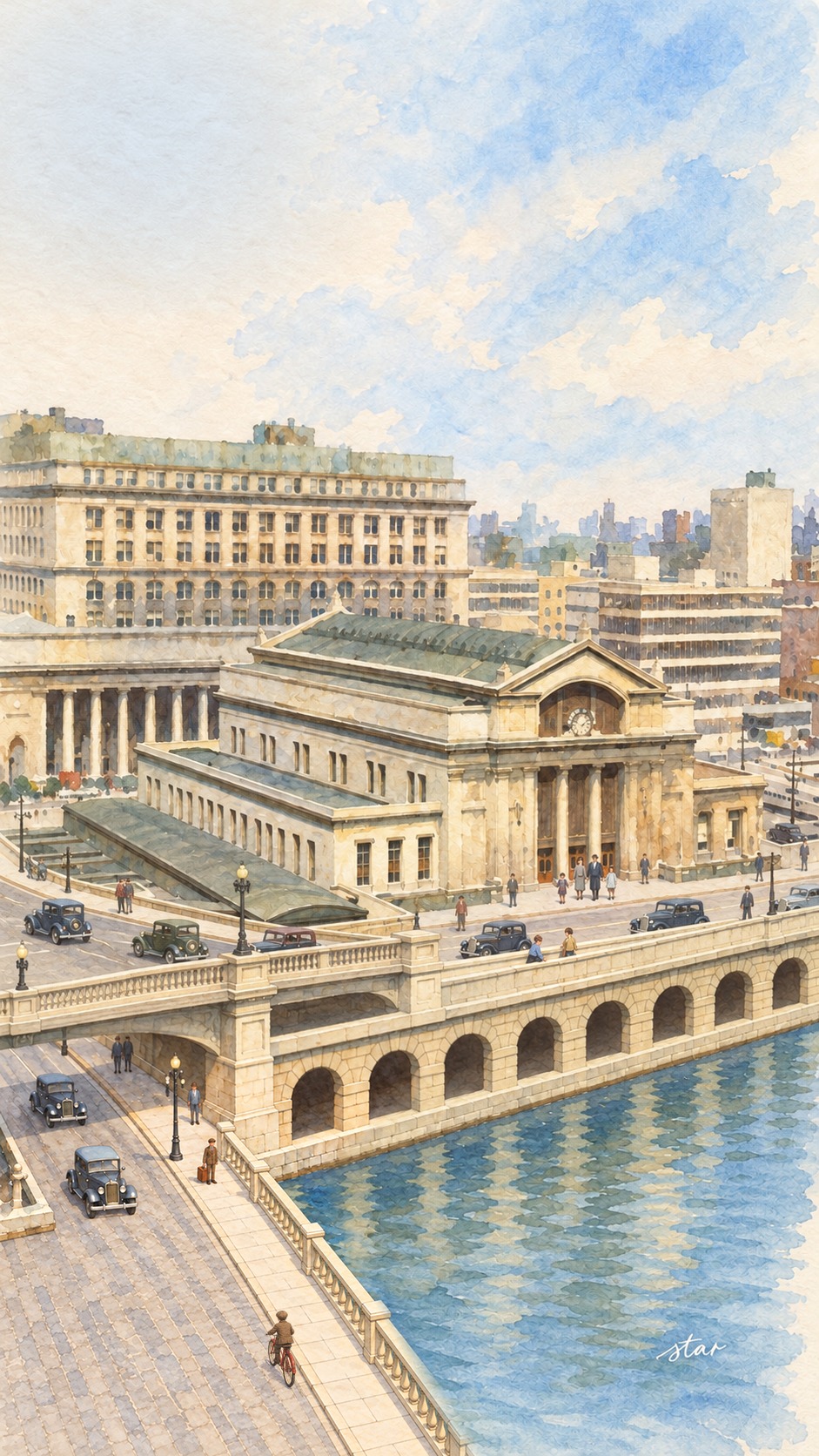
Chicago Union Station is a great American railway terminal that still works as a station. Trains from across the country arrive here, and commuters pour through it every weekday. The Great Hall, with its barrel-vaulted skylight and long benches, has also served as a film set many times.
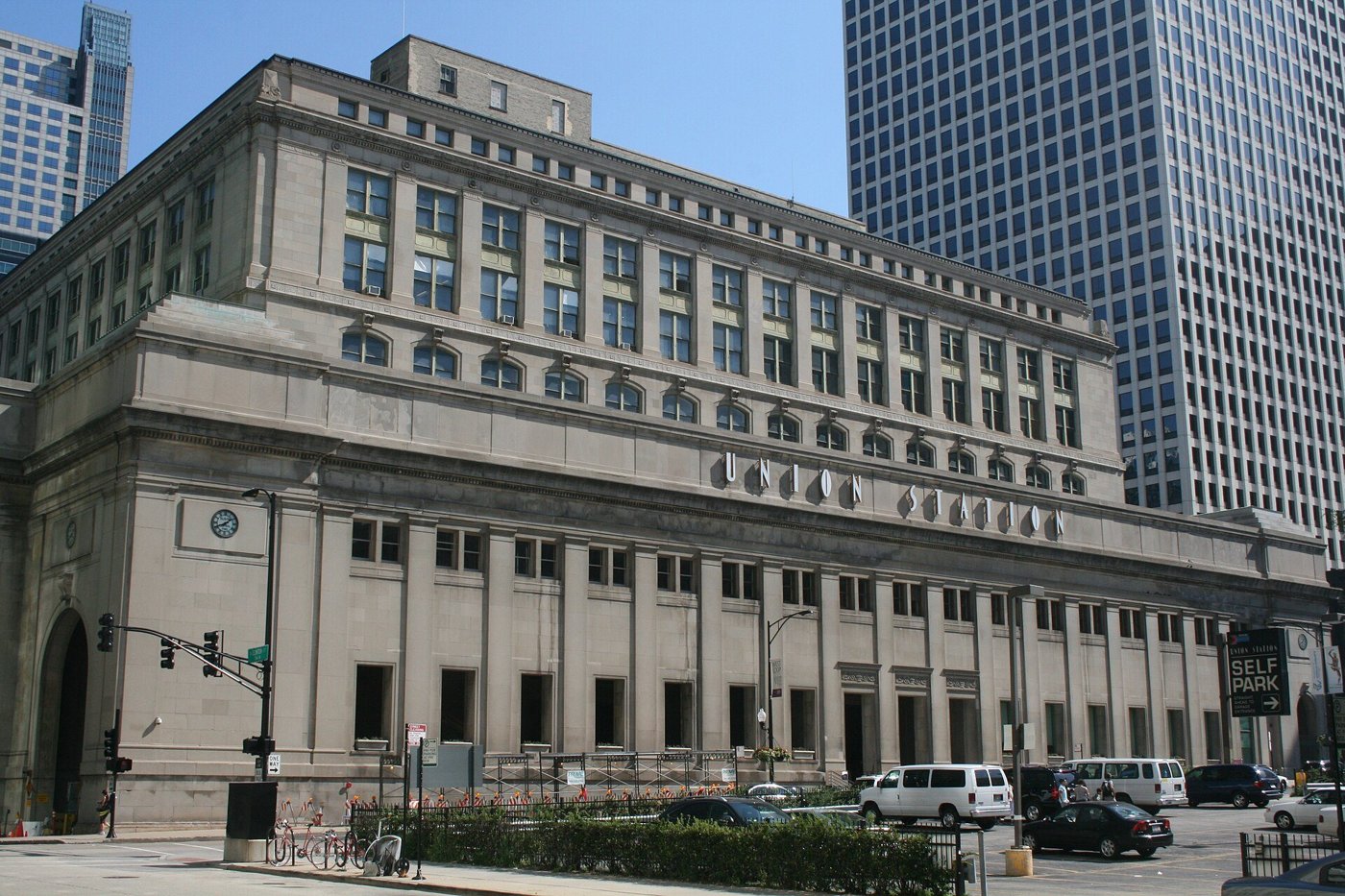
The station sits on a full city block in the West Loop. The Chicago Architecture Center lists the address as 500 W. Jackson Boulevard, and the station's own website uses 225 South Canal Street. It opened on May 16, 1925, according to the Chicago Public Library. Its story starts earlier, in a plan for the city that Daniel Burnham published in 1909.
Burnham's vision
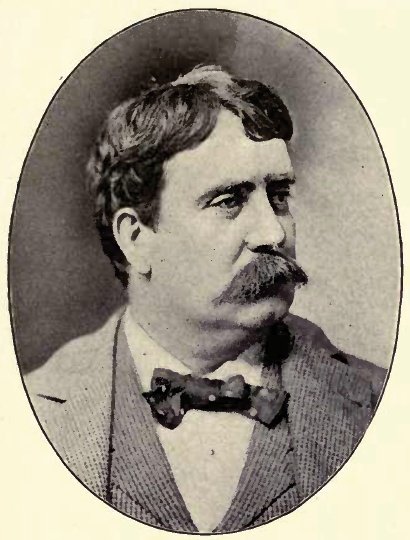
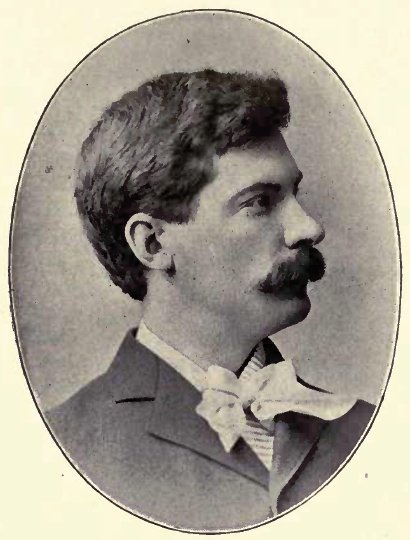
The Architecture Center says Burnham saw the station as a major part of the development of the West Loop in his 1909 Plan of Chicago. He considered it prudent to consolidate train stations and free up land for development, in a city that was still growing after the Great Fire of 1871.
Burnham died in 1912. The design and construction passed to Graham, Burnham & Co., later Graham, Anderson, Probst & White. Construction began in 1913, the Chicago Public Library says, and the station opened in 1925 after about ten years of work. The American Planning Association says World War I caused delays. The cost was $75 million, which the Architecture Center puts at more than a billion dollars today.
A shared railway terminal
The "union" meant a shared terminal, but summaries count its participating railroads differently. The Chicago Architecture Center describes four, naming Pennsylvania; Chicago, Burlington & Quincy; Michigan Central; and Chicago, Milwaukee & St. Paul. Amtrak's 2023 station fact sheet says five railroads formed the Chicago Union Station Company in 1913. That difference should be left visible rather than turned into a falsely exact corporate history. The practical idea was to combine facilities instead of duplicating terminals.
The Chicago Public Library and the station's website both note that construction included more than the building. It also covered the rail yards leading into the station and the many blocks of viaducts and bridges that separated trains from other traffic. The library adds that, unlike earlier terminals, the entrances were designed for car traffic, with places for drivers to pull up at the curb.
The limestone headhouse occupies a full block and contains the Great Hall; it is not the whole railway complex. Amtrak describes a "double-stub" arrangement in which most tracks approach from north or south and terminate rather than continuing through the station. This is why the attractive headhouse and the underground boarding areas feel so different. The original concourse stood east of Canal Street toward the river, joined to the headhouse, while tracks and air-rights development extended well beyond its walls.
The Great Hall
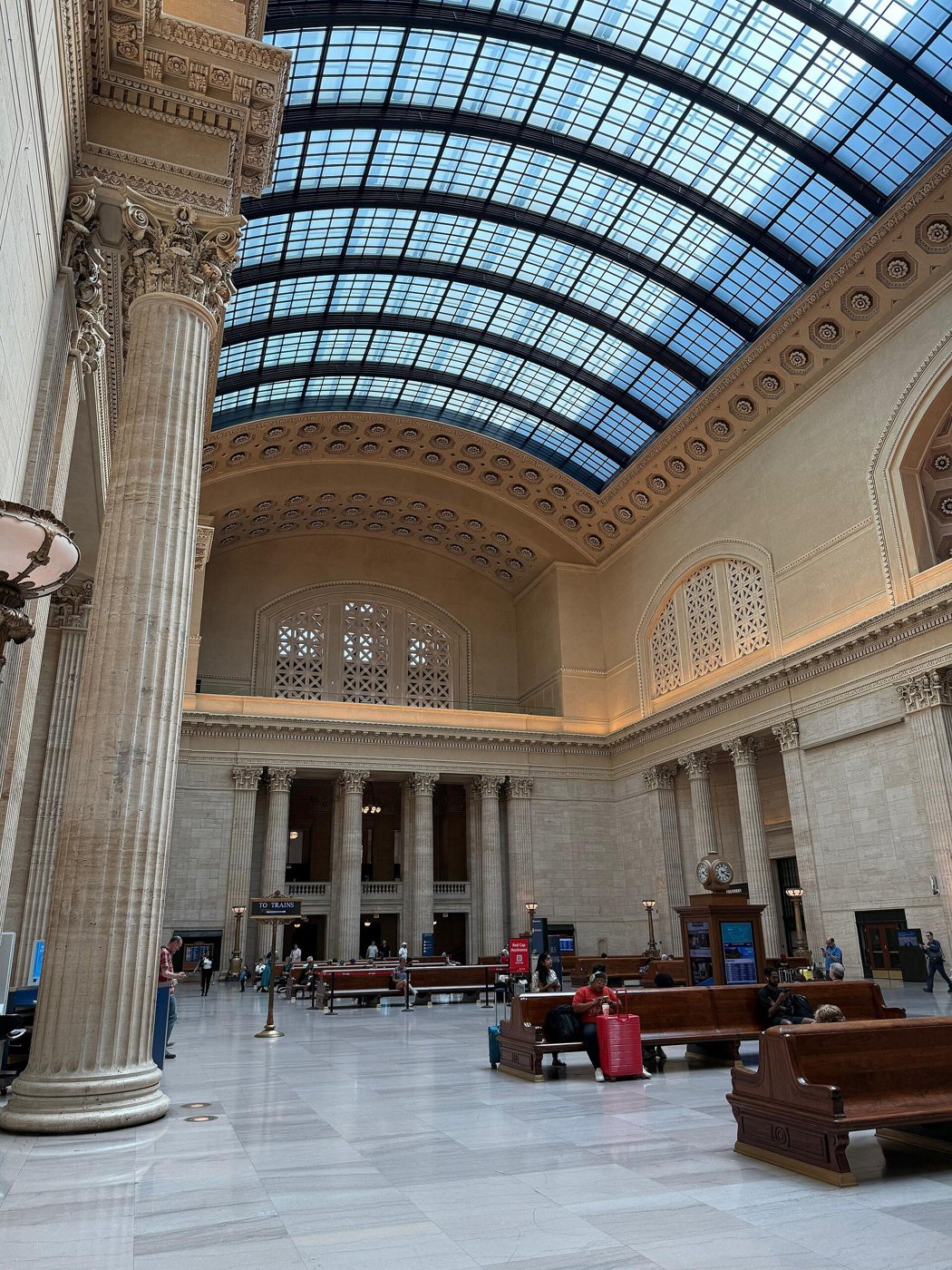
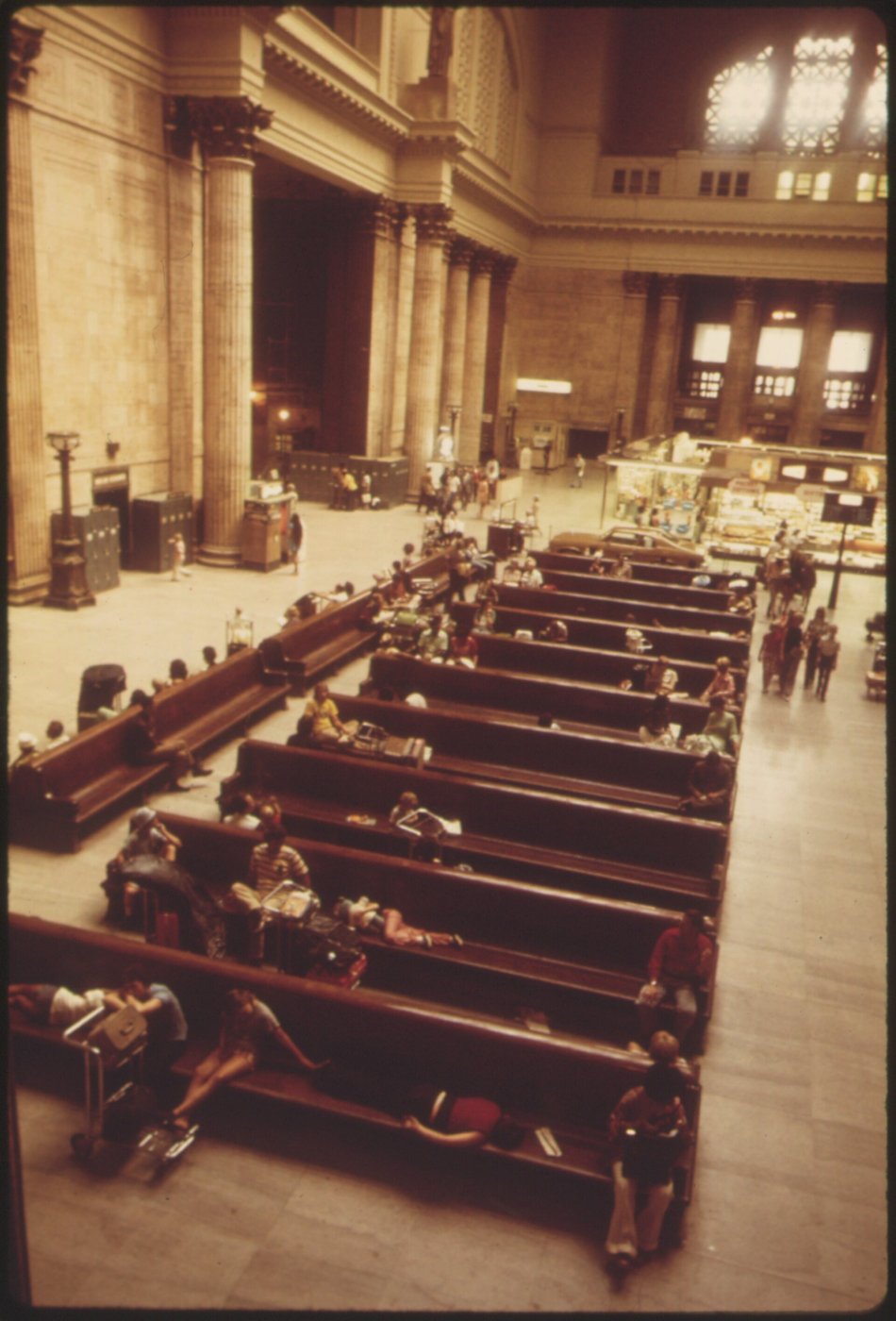
The hall is the heart of the building. The station's own history describes the main waiting room as spanned by a 219-foot barrel-vaulted skylight that soars 115 feet above the floor. The American Planning Association lists Corinthian columns, Tennessee marble floors and brass lamps. The Architecture Center adds that long oak benches, and light fixtures and chandeliers decorated with birds, bees, butterflies and flowers, are original.
Two statues by Henry Hering stand on the east wall and represent day and night, a nod to trains running at all hours. The APA says one holds a rooster and the other an owl. The Chicago Tribune, quoted by the library, wrote in 1925 that "in respect to both architecture and utility, the new station is one of the most impressive in the world."
At opening the station also held a hospital, a chapel and a jail cell, the library says. The Architecture Center lists a small jail for transported prisoners, a Victorian-era women's lounge, a nursery and a first aid station. Fred Harvey's lunchroom and restaurant was a highlight of the new building, the library notes.
Decline and change
Rail travel fell after its peak and the station lost parts of itself. The APA says the "L" station was removed in 1958 and the Concourse Building was demolished in 1969. The Chicago Daily News and Post Office buildings were built over the station's air rights to the north and south. Two long-closed historic restaurants, the Fred Harvey Coffee Shop and the Gold Lion, were destroyed when a fire swept through that part of the station in 1980, according to the Architecture Center.
Amtrak assumed full ownership of the station in 1984. A five-year, $32 million renovation that included new escalators and a redesigned food court was finished in 1992, the APA says.
A long restoration
The Architecture Center says Amtrak has overseen a renovation effort that began in 2010, guided by CBRE and the Chicago architects Goettsch Partners. The first steps were basic infrastructure, including a heat pump, sprinklers and electrical transformers. After being without air conditioning since the 1960s, the Great Hall was cooled again in 2011.
The skylight was blacked out during World War II as a security measure. The Architecture Center dates its major restoration to 2018, while Amtrak's 2023 fact sheet dates completion of the $22 million project to 2019. Contractor Berglund explains that a new high-performing skylight was installed five feet above the restored original system, increasing daylight by about half. A suspended work deck protected the hall without filling the passenger floor with scaffolding legs. The project preserved the historic interior while addressing leaks rather than merely repainting the ceiling.
Goettsch Partners' list of recognition for the work includes the 2020 Crombie Taylor Award from the American Institute of Architects, Illinois Chapter, and a 2021 Landmarks Illinois Driehaus Foundation Preservation Award. The station was named a Chicago Landmark in 2002, and the American Planning Association named it one of America's Great Places in 2012.
Still busy
The station remains an active intercity and commuter hub, not simply a preserved monument. Amtrak's 2023 fact sheet described more than three million annual Amtrak customers and about 147,000 yearly train movements, including passenger trains and equipment positioning. Those are dated figures, not a certified November 2026 count. Metra's current station page lists six commuter services: BNSF, Heritage Corridor, Milwaukee District North and West, North Central Service, and SouthWest Service. This traffic gives the architecture its continuing purpose.
Visiting Chicago Union Station
The station uses 225 South Canal Street as its contact address; the historic headhouse also has the 500 West Jackson Boulevard address. Its January 2026 map identifies the Clinton Street main entrance at 221 South Clinton. Follow current wayfinding for boarding rather than assuming the Great Hall is the platform entrance. The map places the CTA Clinton Blue Line two blocks south and the elevated Brown, Pink, Orange and Purple Lines about three blocks east.
Late access needs care. Checked November 9, 2026, the station's contact page lists daily hours of 5 a.m.-midnight, but Metra lists its waiting room as 5 a.m.-1 a.m. and the Great Hall as 5 a.m.-11 p.m. These direct sources disagree. Do not plan a midnight architectural visit around the older blanket 1 a.m. closing claim; confirm the entrance and waiting area needed with the station or your train operator. Metra marks the station accessible, but individual boarding assistance and elevator routes should be checked for the journey.
Famous movies with scenes shot at this building
The Untouchables (1987) used Union Station's southern Canal Street staircase for the gunfight and runaway-baby-carriage sequence. Amtrak's fact sheet identifies that location, and Movie-Locations describes the scene in which Eliot Ness and George Stone intercept Capone's bookkeeper. It is a real station interior used for a fictional Prohibition-era episode, not a documented account of a gunfight that happened on these steps.
The carriage sequence recalls the Odessa Steps scene in Battleship Potemkin. Kevin Costner played Ness, and his accompanying portrait was taken in 2016, not during the film. The Chicago Public Library also lists The Sting, The Blues Brothers, My Best Friend's Wedding and Flags of Our Fathers among productions associated with the station. That list alone does not locate every scene inside the Great Hall, so specific rooms should not be invented for those titles.

Who owns Chicago Union Station today?
Amtrak owns Chicago Union Station. Its published fact sheet says the Chicago Union Station Company became wholly Amtrak-owned in 1984 and was dissolved into Amtrak in 2017. Metra operates six commuter lines here, but operating trains and using platforms does not make it the building owner. The station's current contact page lists CBRE's management office, another role distinct from ownership.
The headhouse, railway facilities and nearby air-rights developments should not all be treated as one current parcel. Amtrak's fact sheet describes earlier sales of air rights and the 2019 sale of the former parking-structure property south of the station. It also explains the pedway's connection to the transit center and 320 South Canal. This review did not independently search every current deed or access agreement. An old Amtrak-Metra dispute is not evidence that today's station ownership changed.
Where can you eat or drink at Chicago Union Station?
Food-court outlets have their own schedules. Chick-fil-A's direct Chicago Union Station page lists 225 South Canal Street, 312-526-3743, Monday-Saturday, 7 a.m.-7 p.m., and Sunday closed. The station directory's adjoining labels and hours can be hard to associate reliably; the restaurant's own branch page is used here. Hours were checked November 9, 2026 and may change for holidays.
Pret's direct Union Station branch page now supplies hours that the earlier article could not confirm: Monday-Friday, 6 a.m.-10 p.m.; Saturday-Sunday, 7 a.m.-6 p.m. It identifies the food-court branch on the second floor at 225 South Canal and gives 312-763-6494. This is useful for a sandwich or coffee without relying on an uncertain directory layout. Other outlets, including Auntie Anne's and The Junction, appear in the station directory, but their schedules should not be inferred from the station's opening hours. Buying food does not confer access to a private passenger lounge.
Sources
- Chicago Architecture Center: station history
- Amtrak: 2023 station fact sheet
- Station: current contact and hours
- Metra: current station information
- Station: January 2026 map
- Chicago Public Library: centennial history
- Berglund: skylight restoration
- Chick-fil-A: direct branch hours
- Pret: direct Union Station branch
- Station: dining directory
- Movie-Locations: The Untouchables
- American Planning Association: 2012 Great Place
- Goettsch Partners: restoration awards